Plastic pollution has become a major global environmental challenge due to its persistence, low recycling rates, and inadequate waste management. Microplastics (MPs), particles smaller than 5 mm, are now widely detected in water, soil, and wastewater systems. Wastewater treatment plants (WWTPs) serve both as critical barriers that remove MPs and as pathways through which residual particles may enter natural waters or accumulate in sludge.
Our laboratory investigates the occurrence, fate, and behavior of MPs in WWTPs across Taiwan. Using field measurements and modeling approaches, we demonstrated that treatment processes can remove up to 97% of MPs, while particle size and density strongly influence their accumulation in sludge. Seasonal studies across multiple WWTPs revealed significant MP concentrations in sludge (32.79–85.06 × 10³ items/kg dry weight) and highlighted the influence of treatment technology, urbanization, and environmental conditions on their distribution.
Ongoing research focuses on nationwide monitoring, understanding MP dynamics in advanced systems such as membrane bioreactors (MBRs), and applying machine learning techniques to improve detection and mitigation strategies.
Highlights of our work:
• First comprehensive investigations of MP fate in WWTPs across Taiwan
• Removal efficiencies up to 97% during treatment processes
• Evidence of substantial accumulation in sludge phases
• Identification of key factors controlling MP distribution and behavior
• Development of data-driven approaches for MP monitoring and mitigation
Our research aims to support effective management of microplastic pollution and protect aquatic environments and public health.
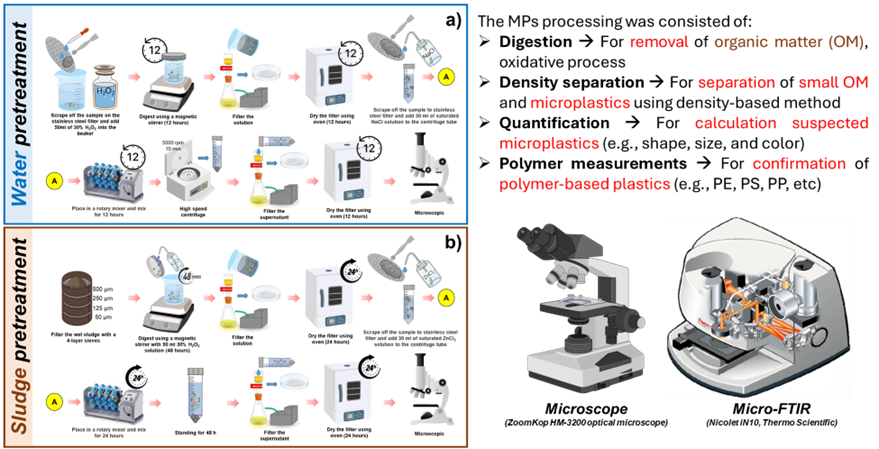 Our protocol on MPs pretreatment. a) water samples and b) sludge samples. (Drawing by Kevin Daffa Prasetya).
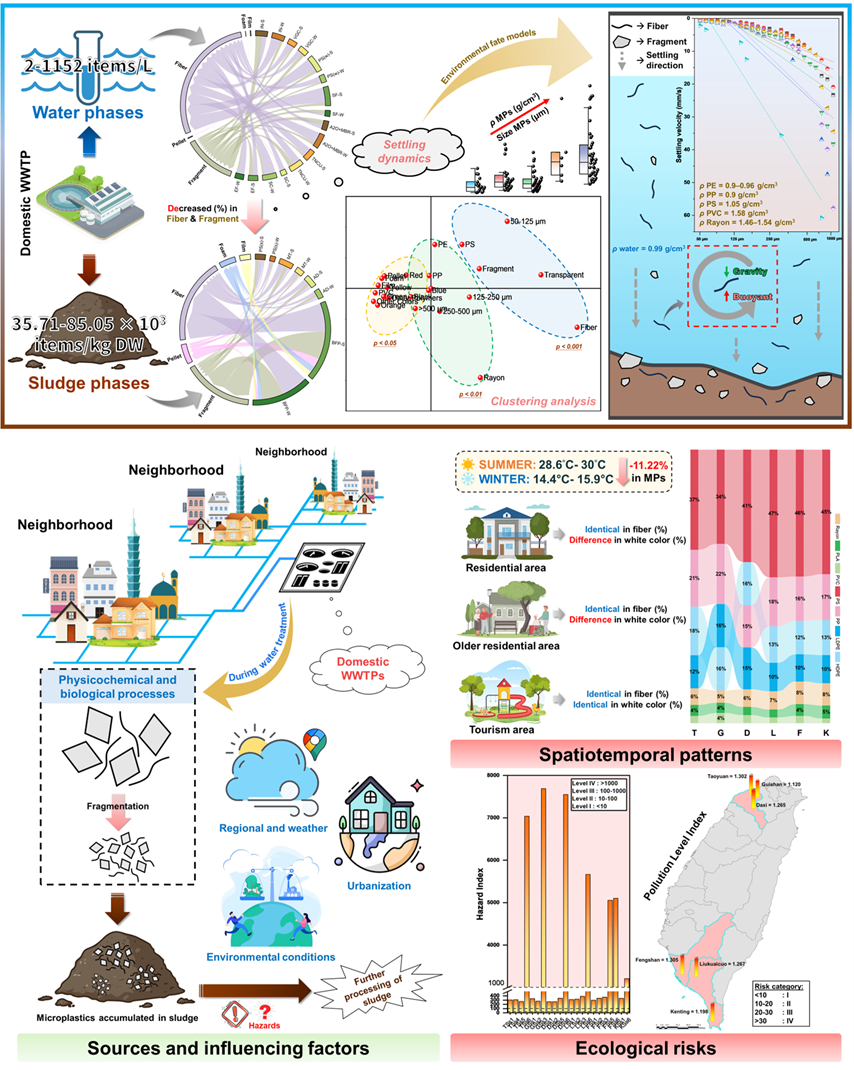 Summarized results of MPs investigation in Taiwan’s WWTPs (Prasetya et al., 2026, 2025).

 The Best Value-AddedService Network in Asia