Our interdisciplinary research largely focuses on the nexus between urban air quality, emerging pollutants, and sustainable environmental systems. So far, we have made significant contributions to understanding distinct characteristics of ultrafine particles (PM0.1; UFPs) in urban microenvironments, while also addressing the broader sustainability challenges associated with transport, industrial emissions, and energy sectors in Taiwan.
Our early review work synthesized the global source, characteristics, and health impacts of UFPs, highlighting the lack of understanding and monitoring data of this emerging pollutants in Asia, particularly in Taiwan. To address this issue, we performed a monitoring campaign using low-cost sensors in three closely located urban microenvironments of Taiwan (industrial, residential, and urban parks). The results highlighted significantly different UFPs and black carbon (BC) levels (UFPs up to 38,000 pt/cm3 & BC up to 2.5 μg/m3 in industrial) within small distances. From this, we found that UFPs levels might vary in small urban microenvironments, unlike PM2.5 and PM10. Therefore, we leveraged interpretable machine learning (ML) techniques to develop accurate models to estimate UFPs exposure levels and their potential emission sources in urban areas. The models not only delivered high predictive performance (R2 > 0.96), but also offered interpretable outputs to inform urban exposure management and epidemiological risk assessment.
Apart from these, we also investigated the environmental impact aspects of Taiwan’s environmental policies spanning from net-zero emissions in semiconductor & energy industries to transport electrifications. In the semiconductor sector, we analyzed chemical footprint of semiconductor manufacturing process from 141 exhaust stacks and the treatment efficiency of various integrated air pollution controls (APCs). On the other hand, we also analyzed the potential trade-off of air pollutants and CO2 emissions in seven major power plants of Taiwan. We found that as many power plants retrofit and add the number of APCs to treat flue gas pollutants (SO2, NOx, PMs), they also increase indirect CO2 from the higher energy consumption of APCs. We applied TODIM multi-criteria decision-making (MCDM) model to evaluate the most optimized APCs configuration. In urban transport sectors, our high-resolution spatial analysis found that the progress of Taiwan electrification policy is still heavily concentrated in urban agglomerated cities such as Taipei and Tainan with the non-exhaust PM emissions of up to 14 times higher than in non-urban areas. This trends are influenced by the disparity in socio-economic status of each city. Beyond this, we also expanded this research internationally by designing a traffic-related air pollution monitoring campaign in Zurich’s city center. Using UFPs, BC, and PMs data, we developed 16 high-resolution (50 m × 50 m) pollutant distribution maps and successfully scaled spatial patterns from localized monitoring to the city level by integrating land-use, traffic, and socio-economic predictors into modeling frameworks. In summary, our research not only contributes to scientific knowledge, but also supports evidence-based policy development aligned with Taiwan’s current net-zero goals.
RESEARCH RESULTS FIGURES
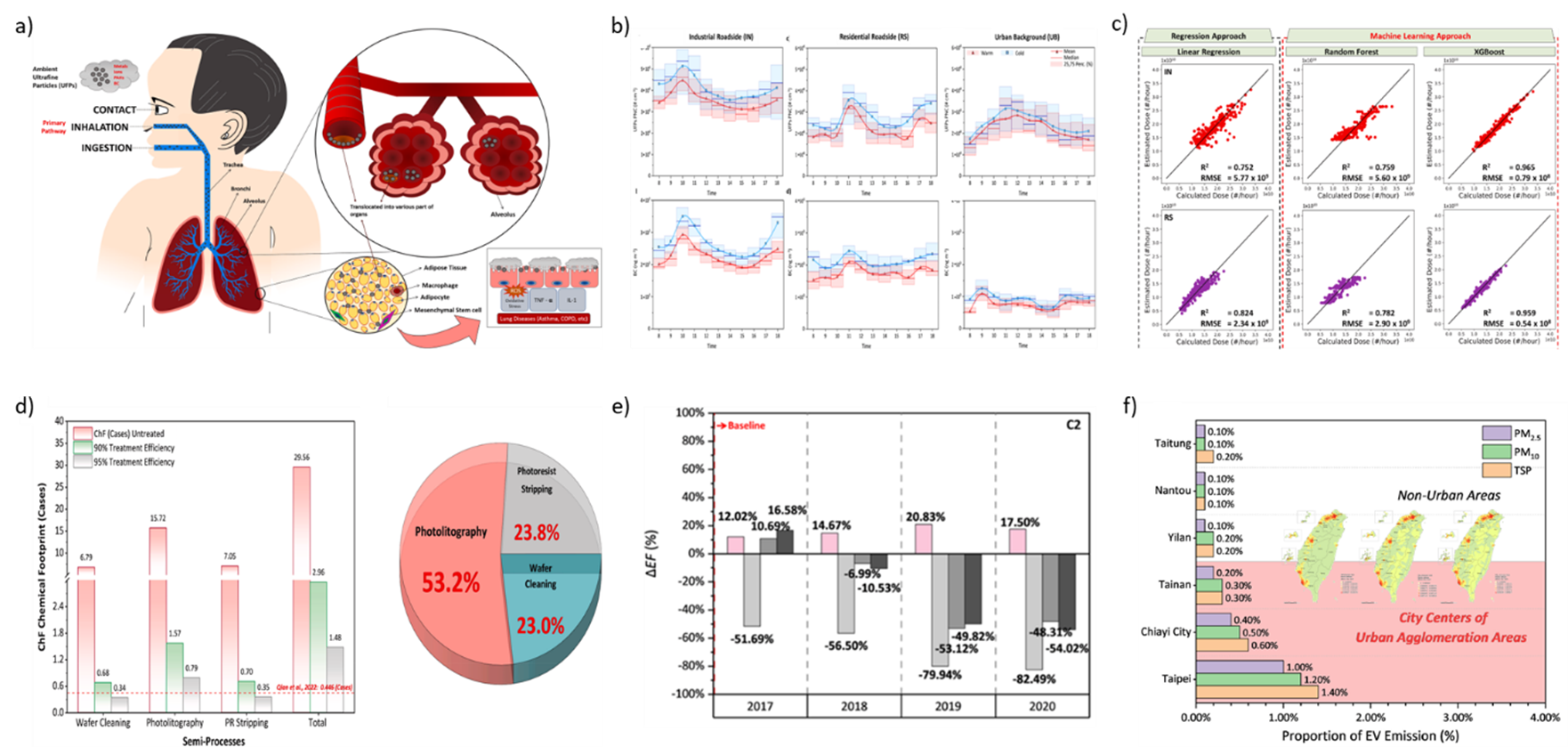 (a) Exposure mechanism of UFPs, (b) UFPs and BC levels in three urban microenvironments, (c) Performance of developed ML models for UFPs estimation, (d) Chemical footprint of semiconductor manufacturing process, (e) Trade-off between CO2 and air pollutants in power plants, (f) Distributions of non-exhaust PMs emission from EVs in urban and non-urban cities.

 The Best Value-AddedService Network in Asia