Our research advances membrane distillation (MD) technologies for sustainable water treatment, resource recovery, and desalination. MD is a thermally driven membrane process capable of producing high-quality water from saline, contaminated, or industrial streams while concentrating valuable resources. We investigate conventional MD, hybrid MD systems, and emerging photothermal membrane distillation (PMD) to enable efficient treatment of complex wastewaters and brines, supporting circular water reuse and decentralized purification.
Hybrid configurations developed in our studies—such as MF–MD for chromium-contaminated groundwater and MD–SLM–ED for selective nickel recovery—demonstrate that coupling MD with pretreatment or separation processes improves flux stability, reduces fouling, and enables recovery of high-value metals. Applications to aquaculture wastewater further show MD’s ability to produce clean water while concentrating nutrients for reuse. On the materials side, low-cost hydrophobic coatings (e.g., PDMS-modified membranes) have been explored to enhance liquid entry pressure and wetting resistance, key factors for long-term operation.
Looking ahead, photothermal MD represents a promising next-generation technology that uses solar energy to drive evaporation at the membrane surface, enabling high-flux operation in off-grid or energy-limited settings. Our ongoing work focuses on advanced photothermal materials, Janus membrane designs, fouling control, and real-world testing with seawater and industrial wastewater.
Highlights of our work:
• Sustainable desalination and wastewater treatment using MD technologies
• Hybrid systems enabling recovery of valuable metals and nutrients
• Improved flux stability and fouling resistance through membrane engineering
• Low-cost surface modifications to enhance wetting resistance
• Solar-driven photothermal MD for decentralized water production
Our MD research aims to deliver energy-efficient solutions for clean water supply, industrial wastewater management, and brine valorization.
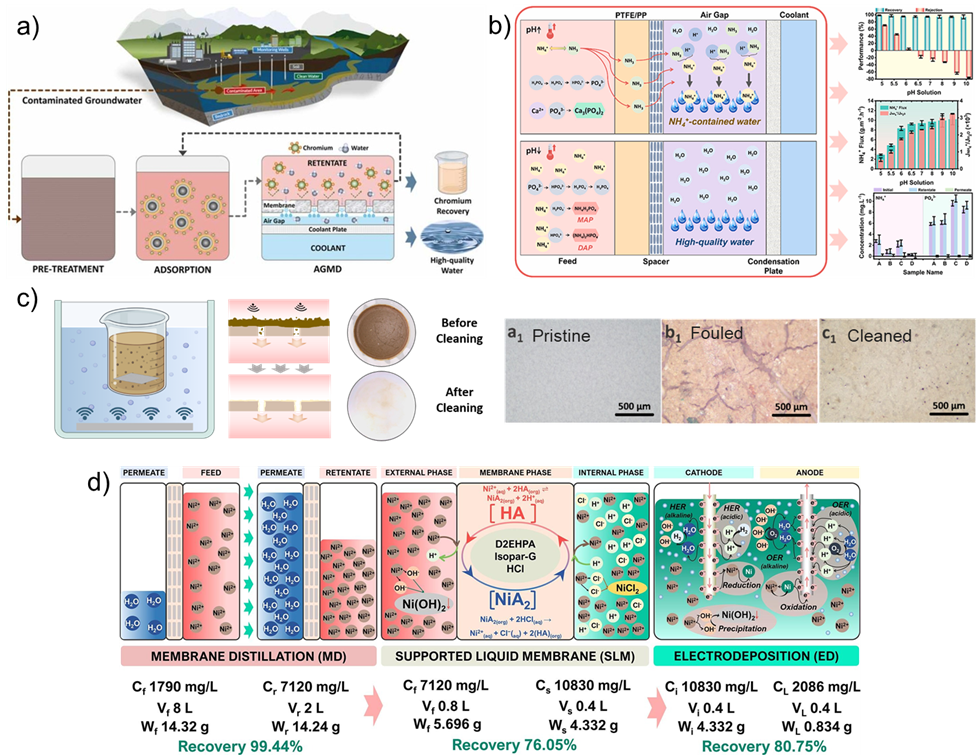 Progress on previous research on membrane distillation application. Ni recovery using integrated membrane distillation (MD), supported liquid membrane (SLM), and electrodeposition (ED) processes (a). Hybrid MF-MD processes are explored to purify high Cr-concentration from contaminated groundwater (c). Air gap membrane distillation is applied for water and nutrient recovery (b). Ni recovery using integrated membrane distillation (MD), supported liquid membrane (SLM), and electrodeposition (ED) processes (d).
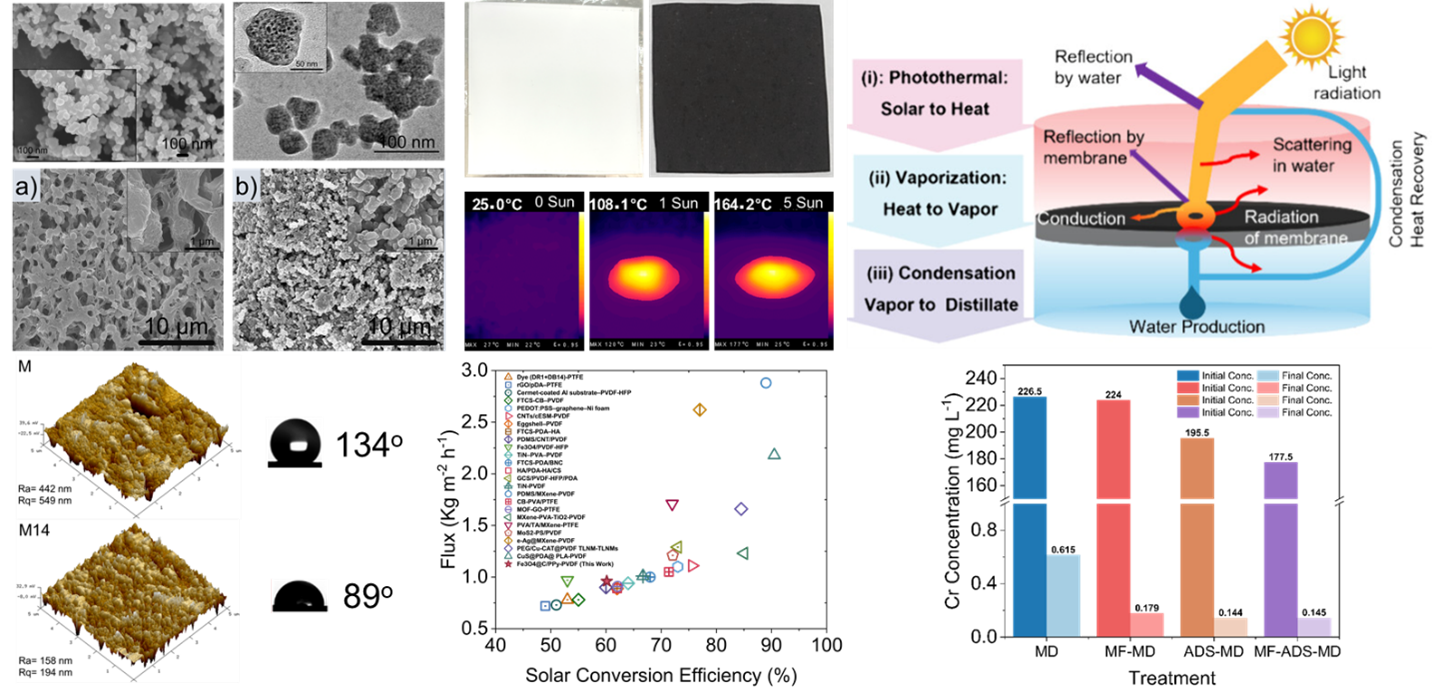 Current research progress on the development and application of photothermal membrane distillation.

 The Best Value-AddedService Network in Asia