Our research develops advanced membrane technologies for energy-efficient gas purification and carbon management. We design polymeric, inorganic, and mixed-matrix membranes to separate key gas pairs such as CO₂/CH₄, CO₂/N₂, and H₂-containing streams, supporting applications in carbon capture, biogas upgrading, hydrogen production, and clean energy systems aligned with SDGs 7, 9, and 13.
Early work established dense polyimide membranes as robust benchmarks for high-pressure separations, leveraging solution–diffusion mechanisms that preferentially transport acidic gases such as CO₂ and H₂S. In parallel, we developed inorganic membranes such as ZIF-8 grown on bio-inspired polydopamine-functionalized supports, achieving high H₂/CO₂ selectivity and structural stability.
Current research focuses on composite and mixed-matrix membranes that integrate selective polymer layers with porous supports or functional fillers (e.g., MOFs such as ZIF-8 and UiO-66-NH₂). These architectures enable ultra-thin selective layers with enhanced permeability, improved mechanical strength, and resistance to high pressures. We also explore carbon molecular sieve (CMS) membranes derived from controlled polymer carbonization, which provide superior molecular sieving for challenging separations.
Future work targets scalable fabrication, defect control, and performance under realistic conditions—including mixed gases, humidity, and pressure variations—to enable practical deployment for CO₂ capture, hydrogen purification, and sustainable gas processing.
Highlights of our work:
• Advanced membranes for CO₂ capture and clean energy applications
• High-selectivity polymeric, inorganic, and mixed-matrix systems
• MOF-based fillers to enhance permeability and molecular sieving
• Carbon molecular sieve membranes for challenging gas separations
• Scalable designs for biogas upgrading and hydrogen purification
Our gas separation research aims to deliver low-energy alternatives to conventional gas processing, contributing to climate mitigation and sustainable energy transitions.
RESEARCH RESULTS FIGURES
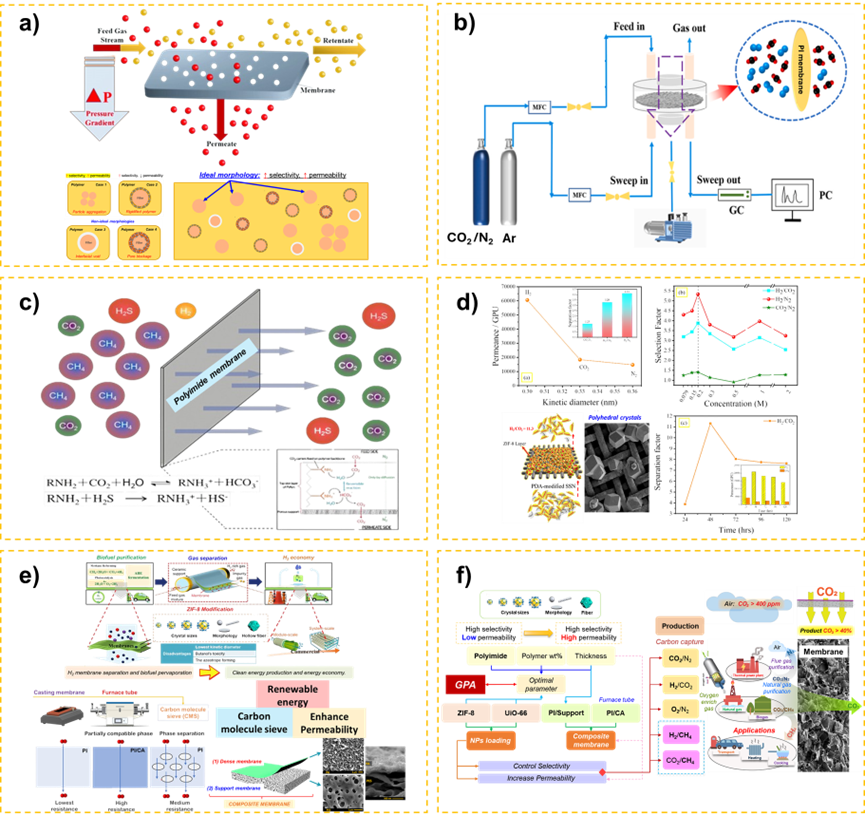 Summarized results of gas separation research. (a) Overview of gas separation membrane, (b) experimental setup, (c) selective CO2/H2S transport through polyimide, (d) performance of PDA–ZIF-8 membranes, (e) composite and CMS membrane concepts, and (f) Future gas-separation roadmap

 The Best Value-AddedService Network in Asia